In short
- Mild soap, lukewarm water and air drying away from heat is the method given in the listings of three mochi sets.
- Still tacky when dry: rinse again, and the same sellers suggest a light dusting of baby powder.
- A squishy with gel or liquid inside that has torn or leaks is not repaired: stop using it and bin it.
- A chemical smell is a safety question, not a cleaning one.
Work out what you are cleaning
Advice depends on what is inside the toy, and the listings in our selection say little outside the first row of this table. Where they say nothing, the cautious route is the gentlest one.
| Type of squishy | What the listings say | Our approach |
|---|---|---|
| Solid rubber mochi sets (JUAUO 32 pieces, DTYDECLE 18, SINZUX 21) | Reusable; wash with mild detergent or soap; dust with baby powder if sticky once dry | Wash as in the steps below |
| Slow-rising foam (ICONRY butter and cheese, suction bread and butter, Mondiko ghost) | No cleaning method given | Wipe the surface with a barely damp cloth first |
| Skin filled with gel, liquid or beads | Nothing in the listings we read | No washing method offered here; check the skin, and see the section on holes and leaks |

 DTYDECLE mini animal mochiView on Amazon

Washing, step by step
Solid rubber and silicone toys
- Look at the toy first. If the skin is cracked, weeping or smells strongly of chemicals, stop here and read the section on holes and leaks.
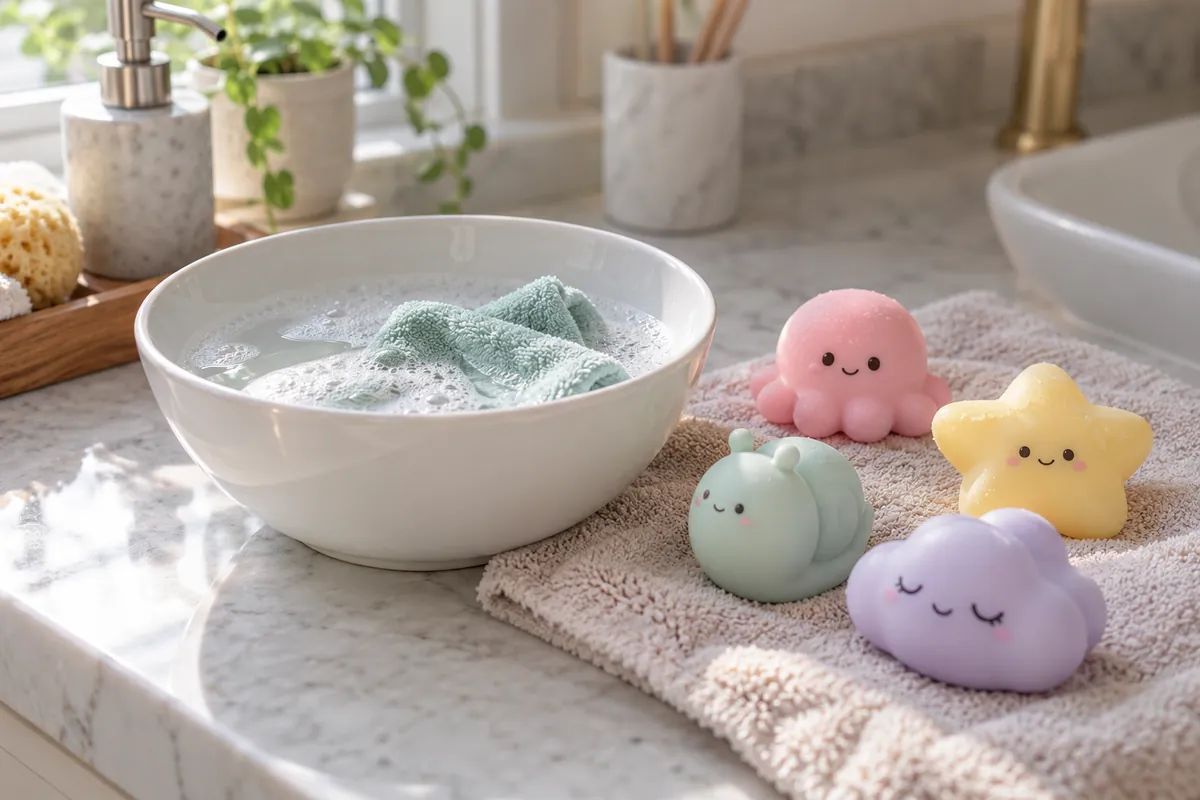
- Fill a bowl with lukewarm water and add a few drops of mild washing-up liquid or hand soap, as the three mochi listings suggest.
- Swish the toy through the water and rub it gently between your fingers. Small pieces can go in a few at a time.
- Rinse in clean lukewarm water until the surface no longer feels slippery.
- Pat dry with a towel, then leave to dry in the air, out of direct sun and away from radiators.
- If it still feels tacky when fully dry, go to the stickiness section below.
Slow-rising foam
Foam soaks up water, so soaking is not a good idea. The usual advice is a cloth with a drop of mild soap, wrung almost dry, wiped over the surface and followed by a second cloth with plain water. Press gently in a towel and let it dry in the air.
The three foam listings in our selection give no washing instructions of their own, so treat this as common practice, not as the maker’s method.
Washing a whole set
Sets are where cleaning takes time. The JUAUO set lists 32 pieces (14 animals, 10 dinosaurs and 8 fruits), DTYDECLE lists 18 packed separately and SINZUX lists 21. Wash in small batches, lay the pieces on a towel and count them back at the end, so none is left in the bowl or under a cushion.
For a wider look at what such sets contain, see mochi squishy sets compared.
Common problems at a glance
| Problem | Probable cause | What to do |
|---|---|---|
| Sticky after drying | Soap film, dust or hand grease on a tacky surface | Rinse again; as a last step, a light dusting of baby powder, which three listings suggest |
| Covered in fluff or grit | A tacky surface picks up whatever it touches | Wash as above, then store in a closed box or bag |
| Pieces fused in a clump | Tacky surfaces pressed together in a bag | Wash and dry them one at a time, then store apart; the DTYDECLE listing says each piece comes packed separately |
| Surface stain or colour mark | Ink, food or dye from another object | Soapy cloth only; skip alcohol and solvents, which can damage the surface |
| Foam that stays flat | Foam is worn out or was soaked | Nothing restores it reliably; do not heat it to try |
| Chemical or petrol-like smell | Not a dirt problem | Stop using it; see are squishies safe |
| Crack, tear or weeping | Skin has failed | Stop using it and bin it; see the next section |
Stickiness, dust and storage
Stickiness after washing
Tackiness often comes back after washing because the surface is naturally clingy. The JUAUO, DTYDECLE and SINZUX listings all say the same thing: if it is too sticky once dry, sprinkle some baby powder. We would add only that a very light layer is enough.
Dust and lint
A clingy squishy gathers dust in a bag or on a desk. Wash it again rather than scrubbing, and keep it somewhere closed afterwards.

Keeping them clean
Prevention is easier than cleaning. A tacky toy left loose in a coat pocket or a school bag collects lint, whereas one returned to its box each time stays in much better shape.
- Use a lidded box or a zip bag, one per set.
- Keep the box off radiators and out of a car in warm weather, the same heat sources the authorities warn about.
- Do not mix soft toys with pens and loose coins, which leave marks.
- Look over each piece when you put it away and set aside any that has cracked.
A hole, a tear or a leak
German consumer organisations advise throwing away a cracked squishy, and the French authority DGCCRF advises stopping its use. No glue, tape or sealing is a safe fix for a skin that holds gel or liquid, and none of the sources we consulted offers a repair method.
Why mending is the wrong idea
Gel clings to skin, and a UK report found a liquid-filled cube whose contents carried micro-organisms above the permitted limit. The OPSS notes that contact with liquid from a damaged or leaking toy could affect some people, for example those with weakened immunity.
A mended skin also does not answer the other risk named by the authorities, which is a gel that tears under hard kneading. A foam squishy that loses pieces falls under the same advice, since torn-off fragments are one of the choking risks described.
What to do instead
- Stop using the toy and keep it away from young children.
- See a doctor if the skin reacts after contact with the contents.
- Photograph the marking and the pack, then bin the toy.
- Tell the seller about the fault.
What does not belong in the bowl
- Alcohol, white spirit, nail-polish remover or any solvent, which the usual care advice rules out for these surfaces.
- Hot water, and any source of heat; the authorities name the microwave, the radiator and a hot car as the settings behind the burns reported.
- Scrubbing with a stiff brush on a soft skin.
On smell: a new squishy that smells of chemicals or petrol should not be washed and kept. Stop using it, and read are squishies toxic for what the authorities have and have not found.
Frequently asked questions
Can a squishy go in the washing machine?
None of the listings we read recommends it. Hand washing in lukewarm soapy water is the method the mochi sets describe.
Is baby powder the only fix for a sticky squishy?
It is the one the JUAUO, DTYDECLE and SINZUX listings name. Rinsing away soap film and drying fully in the air often helps first.
My squishy has a tiny hole. Can I seal it?
No. A skin holding gel or liquid that has opened is not repaired; stop using it and bin it.
How often should I wash one?
When it looks or feels dirty. A sticky squishy that lives in a bag or on a desk picks up dust quickly, so it will need washing more often than one kept in a box.
Will washing remove a chemical smell?
Do not count on it. A chemical or petrol-like odour is a reason to stop using the toy, according to the German consumer organisations.
Can I clean a Squishmallows plush the same way?
Look for care instructions on the plush’s tag or packaging, and follow those. It is a different category from the rubber and foam toys above.
Keep reading: Are squishies safe? Age and checksAre squishies toxic?Mochi squishy sets compared